Everyday life
Life after a laryngectomy is still your life. A few small adjustments help you get back to meals, outings and travel with confidence.

Eating and swallowing
After a laryngectomy, your airway and your food pipe are no longer connected. In one way this is good news, because food and drink can no longer go down the wrong way. But you may notice that swallowing feels different.
These habits can help at mealtimes:
- Take your time when eating and drinking
- Take small bites and small sips
- Chew your food well before swallowing
- Alternate bites of food with sips of drink
If swallowing is difficult, talk to your clinician. Some speech therapists specialise in swallowing problems and may be able to help.
Smell and taste
Smell and taste are a big part of enjoying food. Because air no longer passes through your nose, both may fade after surgery. The good news is that you can learn ways to bring them back during your recovery.
The polite yawn is a simple technique for smelling again. It is easy to learn, and you can do it at the table without anyone noticing.
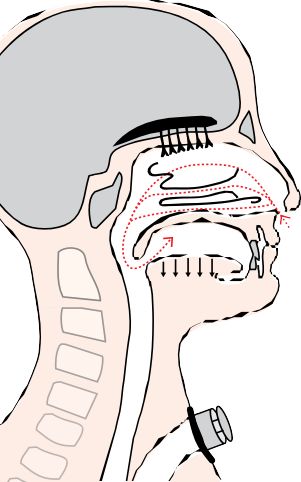
- Close your lips. Keep them closed throughout.
- Lower your jaw slowly, as if you were yawning with your mouth shut.
- Raise it again. The movement pulls air in through your nose, where it reaches your smell receptors.
- Repeat a few times while you smell your food or drink.
Smell and taste are closely linked, so the polite yawn brings back some taste too. Two more things help:
- Chew thoroughly. Chewing moves more air into the nose.
- Enjoy hot food. Rising steam can carry smell up to your nose.
Ask your speech therapist to show you the polite yawn and other ways to retrain your sense of smell.
Water safety
Avoid swimming and boating. If you fall into water, there is no way to stop it pouring into your stoma and lungs. You could drown or be seriously hurt. It is safest not to do these activities at all.
You can shower safely. A shower guard is a small shield that clips onto your HME holder and stops water getting into your airway while you wash.
- If you wear a tube or button, use a shower guard only if it fits tightly in your stoma.
- If you use a night adhesive, reinforce its edges with adhesive strips while you shower so it does not lift.
- A shower guard is made for showering only. It will not protect you while swimming.
Talk to your clinician if you have questions about water.
Going out
Once you have recovered from surgery, getting out and enjoying life is an important part of healing. A small kit makes it easier.
What to carry
- Spare adhesives
- Spare HMEs
- Cleaning wipes
- A small mirror
- A small torch
- Your voice prosthesis cleaning brush, if you have one
- Your emergency card
Let people know you breathe through your neck. Whenever you go out, wear your medical alert or neck breather bracelet, and carry your emergency card. If you are ever taken ill or hurt, anyone helping you will know straight away that air and oxygen must go to your stoma. Don’t have a bracelet yet? Ask us for one.
A filter HME can protect you from dust, pollen, bacteria and viruses when you are on buses, trains or planes, or anywhere crowded.
Travelling
You can travel near or far. A little planning helps:
- Pack more supplies than you think you need, and keep some in your hand luggage.
- Find a clinician at your destination before you go. Your own care team may be able to recommend someone.
- Carry your emergency card, and keep the emergency information page saved on your phone.
Staying active
Many people return to walking, cycling, gardening and the gym. Build up slowly and at a steady pace. When you exercise, switch to an HME with low breathing resistance. Read more about choosing an HME.