A little preparation before your operation can help you feel calmer going in and more at ease when you come home.
Prepare for emergencies
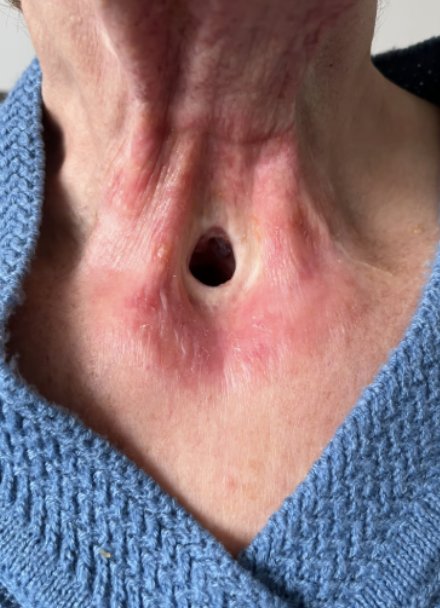
After surgery, you will breathe in and out only through the stoma in your neck. Anyone treating you in an emergency needs to know this straight away, because the usual ways of giving oxygen will not work.
In an emergency, oxygen and rescue breathing must go to the stoma. Giving oxygen through the nose or mouth will not reach the lungs of a neck breather.
A few simple things make sure people know:
- Wear an alert bracelet. A medical alert or neck breather bracelet tells emergency workers that you must be given air through your neck. Many also store your medical details. Ask us for a neck breather bracelet.
- Carry an emergency card. Keep one in your wallet where it is easy to see, and another by your bed.
- Put a sticker on your window. A neck breather sticker on your car or front window alerts anyone coming to help.
- Set up the medical ID on your phone. Most smartphones let you store your medical history and an emergency contact that can be seen without unlocking the phone. Look in your phone’s settings, or ask someone to help you set it up.
You can also keep our emergency information page saved on your phone to show to anyone who needs it.
Talk to your local emergency services
Rescue breathing is different for people who breathe through the neck, and emergency workers may not see it often. Before your surgery, it helps to:
- Tell your local ambulance and fire services that you will breathe only through your neck, and that any oxygen must be given to your stoma.
- Explain that you may not be able to speak for a while after surgery.
- Ask whether you can contact them by text message in an emergency.
- Record a short message in advance asking for help and giving your address, so you can play it down the phone if you cannot speak.
The booklet Rescue Breathing for Laryngectomees and Other Neck Breathers by Dr Itzhak Brook is a useful guide to share with them. Your care team may be able to give you a copy.
Plan how you will communicate
For a while after surgery you will not be able to speak with your voice. Planning ahead means you can still make yourself understood from the first day. Options include:
- Pen and paper, a wipe-clean whiteboard or a small LCD writing tablet. Pack one in your hospital bag.
- A text-to-speech app on your phone or tablet. Download it before surgery and try it out so you are comfortable with it.
- Gestures and mouthing words. Agree a few simple signals with the people closest to you.
Some people also begin using an electrolarynx while still in hospital. Read more on speaking again.
Arrange your supplies
You will need some special supplies once you are home, such as heat and moisture exchangers (HMEs) and the adhesives that hold them in place. Sorting this out early saves stress later.
- Check your insurance. Ask your insurer which laryngectomy supplies are covered and which suppliers they work with.
- Ask suppliers what they stock. Not every medical supplier carries laryngectomy products, so check that they have the specific items you will need.
- Open an account in advance. If your care team tells you that you will need supplies after surgery, set up an account with the supplier before you go into hospital. Your first order will reach you faster.
Work and big decisions
Many people carry on working after a total laryngectomy. The weeks before surgery can be stressful, so try to put off big decisions about your job until after you have recovered. If you want to go back to work, tell your care team. They can help you plan towards it.
Keep your goals in sight. A laryngectomy changes your daily routine, but most people return to the things they enjoyed before, like exercise, seeing friends and travelling. It can help to keep those goals in mind every day.
The first weeks are about healing and getting used to a new routine. Be patient with yourself. Full recovery takes time.
Your hospital stay
Most people stay in hospital for several days after a total laryngectomy. How long you stay depends on how you are recovering, and your medical team will make that decision with you.
Signs you are ready to go home
Your team will usually look at four things:
- Healing. Is your wound healing well?
- Nutrition. Are you eating and drinking enough?
- Pain. Is your pain under control?
- Communication. Can you make yourself understood by the person caring for you?
Communicating while you heal
There are several ways to communicate in the days after surgery: writing, gestures, mouthing words, a communication app on your phone, or an electrolarynx. Keep a pen and paper or a writing board within reach.
Some people start using an electrolarynx while still in hospital. Whether you can depends on how you are healing and whether your team feels you are ready.
If you have a voice prosthesis, you need to wait until you have healed before you begin speaking with it. Your doctor will tell you when you can start. This is often after you have left hospital.
Caring for your stoma
Coming home means learning to look after your stoma. It now leads straight to your lungs, so how you care for it really matters.
- Keep it covered with an HME, all day and all night. The HME warms and moistens the air you breathe and helps keep harmful particles out of your lungs. It does the job your nose used to do. Read more on breathing and stoma care.
- Keep it clean and free of mucus. Your clinician will show you the best way to do this.
- Never clean it with anything small enough to fall in. Your little finger is a good guide to compare against the size of your stoma.
- Expect it to shrink a little as it heals. This is normal.
Get help straight away if your stoma becomes so small that breathing is difficult, or if dry, crusty mucus builds up and makes it hard to breathe. This is called a mucus plug and it can be dangerous. Contact your clinician or emergency services immediately.